
Finding Who Owns a Carroll County Property
Ownership in Carroll County shows up in two kinds of property records. The assessment roll carries the tax owner. Recorded instruments at the Clerk carry the deed trail. Begin with the address you know. Let Web GIS lead you to the parcel and its tax-map key. Its owner detail is not confirmed in the public view.
Keep every step tied to one parcel. A single name can attach to several tracts. The tax mailing address may sit far from the land itself. A deed may name an estate, a trustee, or a company instead of a person. The legal name can differ. Bridge the gap with the recorded instrument and the entity filing rather than a guess.
- Locate the exact Carroll parcel from its 911 address and copy the complete tax-map number.
- Ask the Commissioner of the Revenue for the assessment record and the owner name carried on the roll.
- Search that owner as grantee in the Circuit Clerk land index and inspect the newest deed.
- If the deed names an entity or estate, check its official filing or probate instrument before connecting it to a person.
Carroll County’s Tax-Roll Owner
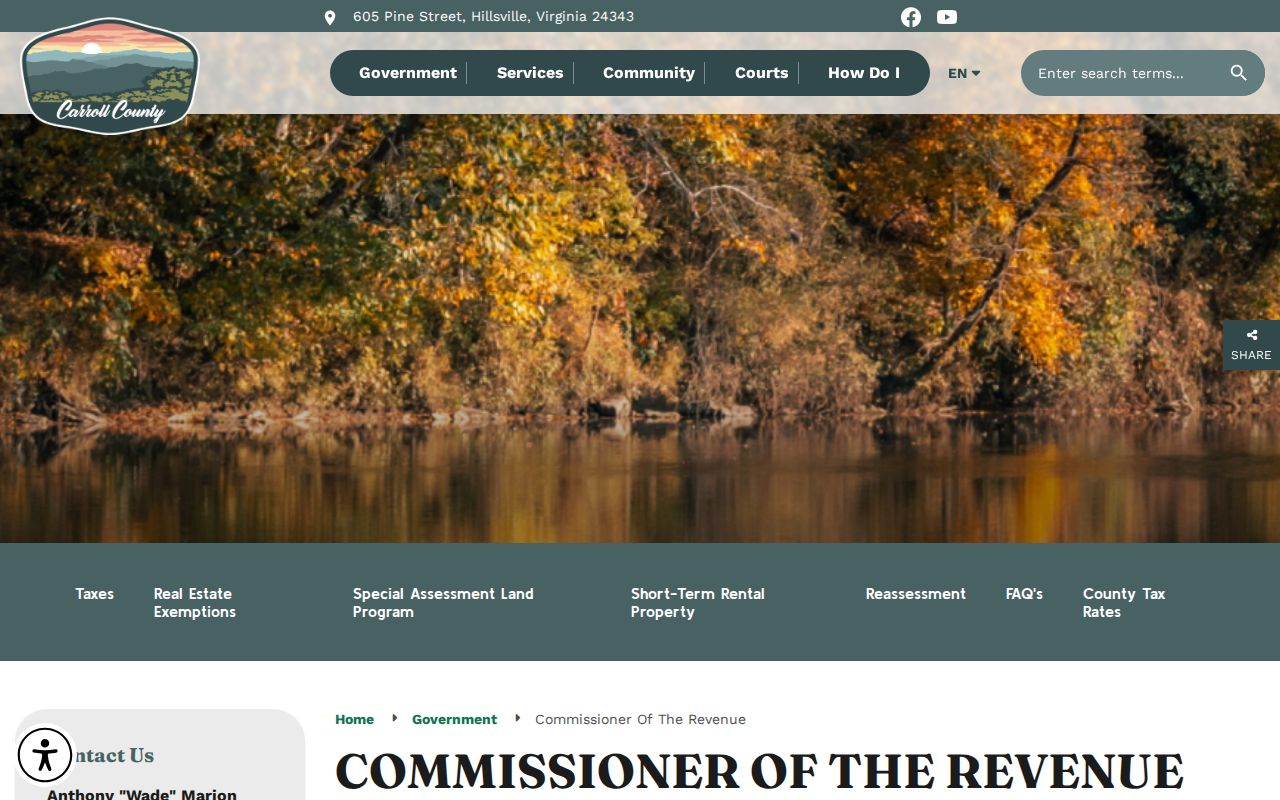
The Commissioner of the Revenue identifies property for tax purposes and maintains the assessment books. The office updates records for transfers, splits, permits, new construction, and map corrections. It also administers exemptions. Its public pages offer no address, owner, or parcel-card search. That limit matters. A map label is not the full story. A tax-payment account should never stand in for the complete owner record either.
Call the real-estate line at 276-730-3030 or visit 605-7 Pine Street in Hillsville. Ask what owner and assessment data staff can pull for a specific map number. The county counts 32,462 taxable parcels and 1,274 exempt ones. An exact parcel key helps them find the right entry fast.
The Commissioner's page outlines the office's assessment duties and the roll it keeps.
The roll gives a tax owner to verify; the deed shows the recorded transfer itself.
Where Carroll County Ownership Appears
Ownership checks in Carroll County work best when each source gets one narrow job. The tax roll supplies the county's owner-of-record and assessment context. The deed index lists parties to recorded land transfers. GIS places the parcel on a map. SCC filings can identify an LLC or corporation. The entity may be named in a deed. None of these alone replaces the full land record and chain of title.
| Source | Owner Info It Gives | Access |
|---|---|---|
| Commissioner assessment roll | Tax owner and assessment data, if supplied | Phone or office; public card URL not found |
| Circuit Clerk deed index | Recorded grantor and grantee parties | SRA agreement, counter, or request |
| County Web GIS | Parcel shape, key, road and map context | Public viewer after terms |
| Virginia SCC | Entity name, status, agent, and filings | Official online system |
An owner-of-record name does not tell you who lives on or uses a parcel. A mailing address is just a tax correspondence route. It may be a business, family, or care-of address. Use the public record for land questions, not to trace a private person's whereabouts.
Remote land-record access carries its own cost and activation step. Carroll County's Clerk requires a signed Secure Remote Access agreement plus a $35 monthly subscription. The Clerk notifies the subscriber once the account is active. Payment works in person, by mailed check, or by phone card with a 4% convenience fee. For a one-time ownership check, the courthouse or a call to the Clerk may be simpler. That is especially true if the online index does not reach the year you need. No online cutoff is published. Ask before assuming a name search covers a given recording date.
Have the full tax-map key ready before calling. Have the exact spelling of the assessed name in hand too. Ask which record confirms the tax owner, and whether a current deed is already indexed. Then compare the deed parties with the Commissioner's entry. If the record names an LLC, estate, or trust, keep that exact grantee style. Follow the relevant filing or probate source rather than guessing who stands behind it.
Carroll County Situs and Mailing Addresses
A situs or 911 address points to the property or its access. A mailing address tells where tax notices go. In rural Carroll County, a Hillsville, Cana, or Fancy Gap postal label may not match any town or county line. Vacant acreage may carry no house address at all. Keep these two address types separate when asking who owns the land.
The tax-map number is the stronger link. It ties the GIS map, the assessment request, the tax bill, and the deed citation together. An owner name may seem to mismatch a street address. Check the legal description and parcel key first. A wrong postal city or an old road label can create a false mismatch.
Confirming a Carroll County Deed
Start with the assessment record and pull the name it lists. Then search the deed books for that name as grantee. Open the most recent instrument. Read its vesting clause, the legal description, and the prior deed reference before trusting anything else. The Circuit Clerk keeps Carroll County's land records. Remote access to the SRA system requires a signed agreement plus a $35 monthly fee. Anyone can search in person or by mail instead. No online index cutoff has been published. So once the chain reaches an older book, ask the Clerk or turn to the Library of Virginia.
Remember what a deed is. It proves a conveyance was recorded, nothing more. It is not a title opinion. Follow up on later deeds, releases, estate instruments, or court orders when the trail demands them. A GIS label or a tax-roll owner should never settle the question after a recent sale.
When Carroll County Deeds Name an Entity
Sometimes a Carroll County parcel belongs to a company under its exact legal name. Sometimes an estate conveys land through an executor or another fiduciary. Virginia's State Corporation Commission runs a Clerk's Information System. It covers entity status, registered agents, principal offices, and filings. Use it to pin down which company the deed names. Then go back to the Carroll deed. Pull the tax-map record too. One caution applies. A registered agent handles paperwork. That role alone does not make the person an owner or manager of the property.
Trust documents and estate files rarely sit online in full. Carroll's Circuit Clerk holds wills and estate filings alongside the land records. Search the instrument itself for the exact trustee or executor role. A probate file may become necessary. If so, ask the Clerk how to reach it. For corporate cross-checks, Virginia SCC's official entity system is the tool to use.
Entity details can clarify who stands behind a deed party name. Even so, the Carroll County instrument itself remains the controlling property record.
When Carroll County’s Roll May Lag
The Commissioner updates assessment and GIS data from transfers, splits, permits, and other land changes. No published refresh period separates a closing from the roll, however. So after a recent sale, a recorded deed can be the fresher evidence. Put three dates side by side. Note the deed recording date. Note the tax year. And note the date the assessment office last updated its record.
What if the public tax name still shows the seller? Ask the Commissioner whether the transfer has reached the assessment book. Then confirm with the Clerk that the deed was actually recorded. Resist calling it an error off one screen. Two records with two purposes simply need reconciling.
Limits of a Carroll County Owner Search
A Carroll County owner lookup shows the records tied to a parcel and a name. It does not prove occupancy, a residential mailing address, or clean title. Protected addresses and state privacy rules still apply. For real title certainty, have a qualified professional review the chain. Then confirm the documents with the Clerk.
Lawful use. Use owner names for property diligence, land history, and civic review. Virginia’s stalking statute, Va. Code §18.2-60.3, addresses repeated conduct intended or known to place a person in reasonable fear; a record is not permission to harass or target anyone.